
London
Harold Cohen
AARON at Tsukuba '85
Oct 16 - 28, 2025
Overview
"Well, I guess if it ever signed a painting on its own, that would signal the end of all debate on the matter of its intelligence."
- Harold Cohen
Details

AARON at Tsukuba '85 - In collaboration with Gazelli Art House, Verisart and the Harold Cohen Trust.
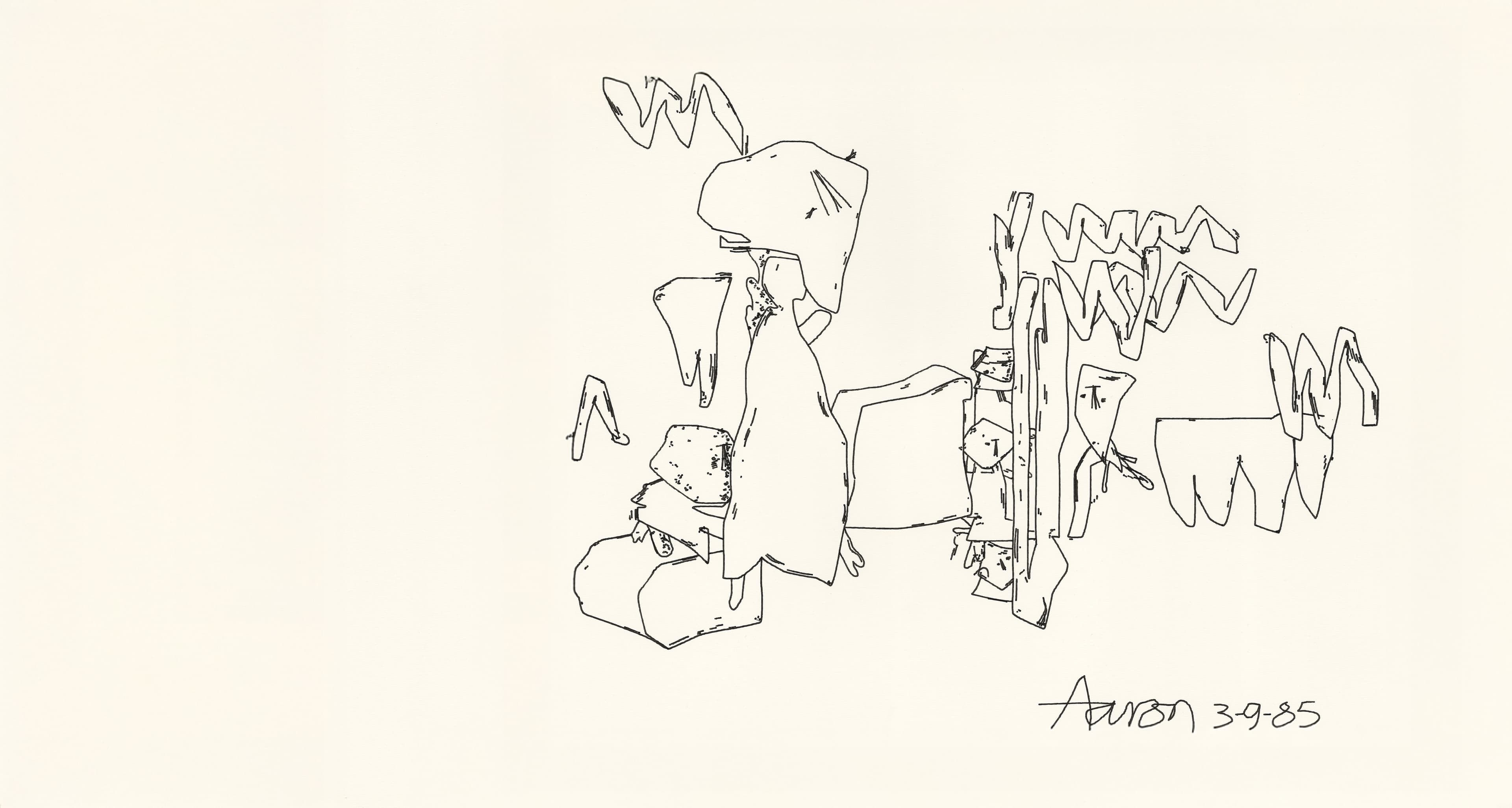
Harold Cohen’s AARON at Tsukuba ’85 drawings are rare witnesses to the first sustained public presentation of autonomous computer art. Created live inside the U.S. Pavilion at the 1985 World’s Fair in Tsukuba, Japan, they were produced by Cohen’s artmaking programme AARON as visitors watched a mechanical plotter generate original ink drawings in real time. Guides explained that AARON “never draws the same drawing twice,” and the installation was singled out in the Pavilion’s report as one of its most popular exhibits.
Heads of state and royalty saw AARON at work. Prime Minister Yasuhiro Nakasone was photographed at the plotter, and Emperor Hirohito extended his official tour to ask questions, a rare protocol exception noted by Pavilion staff. Public response matched the VIP attention. In an open‑ended visitor survey conducted on site, AARON was the top specifically named favourite in the U.S. Pavilion.
What also set the Tsukuba works apart was their unusual inscriptions, which seemed to suggest the possibility of autonomous authorship. Contemporary Japanese press captured the moment with headlines about “computers as artists,” describing AARON as a system that “thinks while drawing.”
Artworks
Harold Cohen
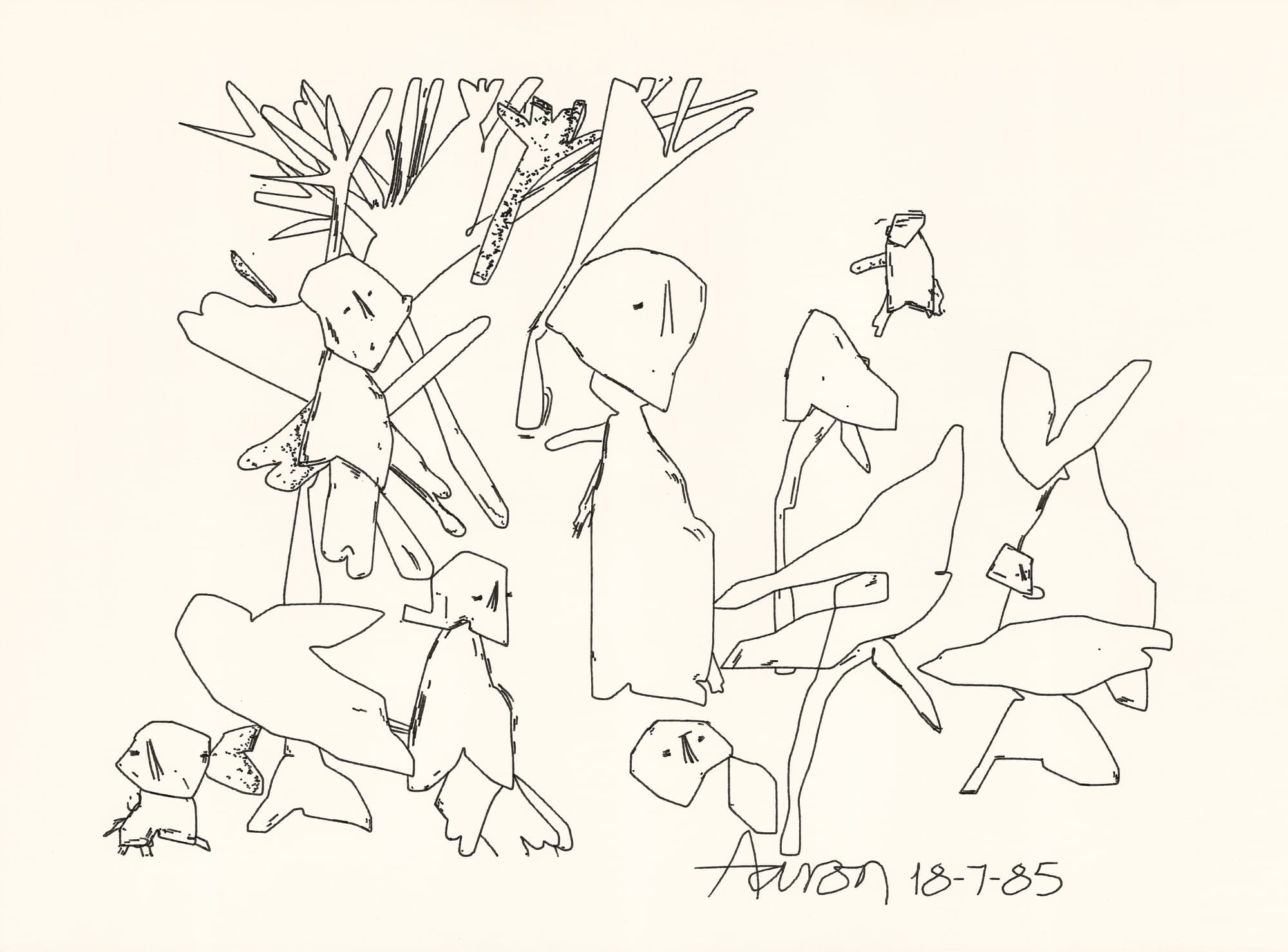
AARON at Tsukuba, #2 18-7-85 (Claim Deed Token)
1985
Medium: Plotter drawing ink on paper
Edition: Unique, h 56.2 x w 76.5 cm
Details
Created
NFC Serial Number
Plotter Status
Medium
Plotter drawing ink on paper
Physical Edition
Unique, h 56.2 x w 76.5 cm
Developed by Harold Cohen, AARON is one of the world’s first cybernetic systems capable of autonomously generating paintings. Remarkably, Cohen embarked on this groundbreaking project without any formal background in computing. Cohen was a prominent painter who represented Britain in the 1966 Venice Biennale. After settling in San Diego, he became interested in the emerging new field of computer programming. It was still performed on punch cards, but Cohen began to teach a computer to paint, modeling the decisions made by an experienced artist. He treated it as though he were teaching a particularly dense art student. “The vast majority of us follow rules that somebody else taught us when we were growing up and going to art school,” Cohen says. “Nobody really invents art from scratch. The computer can, in principle, enact whatever rules you’re capable of enunciating, but enunciating those rules in a computer language is a nontrivial issue.” Cohen taught AARON to paint black-and-white abstractions, then added color, then figuration. He taught it that human bodies fall within a spectrum, how certain types of plants grow, and more. Looking at its paintings, it’s hard to believe that the painter “felt” nothing while making them. Edward Feigenbaum, one of the pioneers of artificial intelligence, considers AARON a remarkable example of AI displaying genuine creativity. “What you call a creative act, it’s actually a behavior that you observe,” he says. “It elicits a kind of emotion of, ‘How did he or she or it think of that?’” Yet Cohen himself disagrees; he considers AARON, into which he has poured 40 years of his life, not to be creative. “I think creativity has to involve self-modification. The creative act has to leave the creator with a different world model than it had before,” he argues. AARON is knowledgeable, but “having a brain and having a life are two different things.”
AARON at Tsukuba ’85 is presented in collaboration with Gazelli Art House, Verisart, and the Harold Cohen Trust.
This Token is a non-fungible, uniquely identified digital token issued by Fellowship, corresponding one-to-one with a specific AARON at Tsukuba, 1985 plotter drawing by Harold Cohen. It represents the right to redeem one authenticated physical Work, which is held in custody by Fellowship until initial redemption. Upon redemption and delivery confirmation, the Token is transferred to a custodial wallet controlled by Gazelli Art House or the Harold Cohen Trust, marking the Work’s “Claimed” state. The Token serves solely as a claim mechanism, does not constitute the Work, a Certificate of Authenticity, or evidence of legal title, and confers no intellectual property rights. It may not be used for any financial mechanics, such as fractionalization or staking. It is a digital claim mechanism only. Subsequent redemptions may be made with Fellowship, Gazelli Art House or the Harold Cohen Trust.
Inventory ID: i23-2017
Signed: "Aaron 18-7-85"
Certificate: https://verisart.com/works/harold-cohen-59b66543-166a-478d-ae9e-e5dcf71346ea